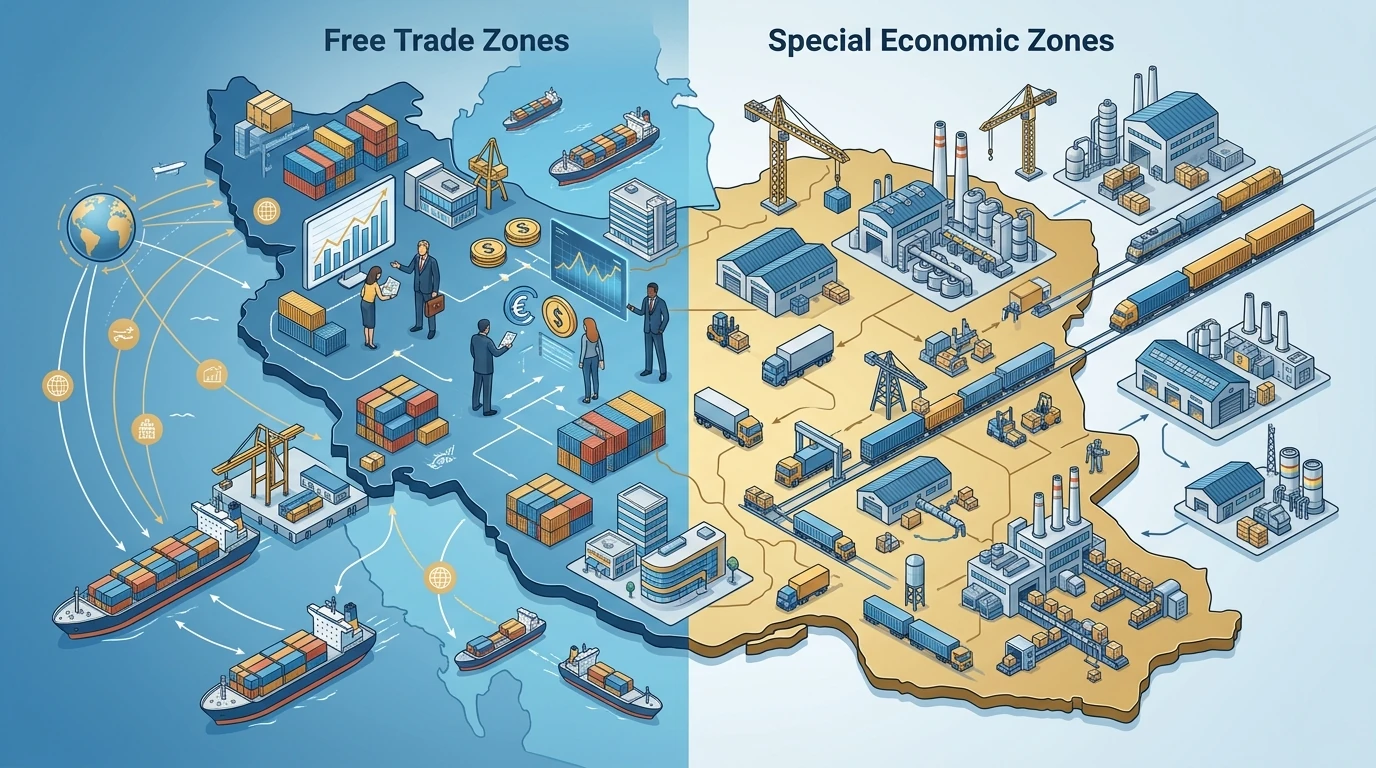
Many investors, companies, and business operators evaluating investment opportunities in Iran encounter two similar terms: Special Economic Zones (SEZs) and Free Trade–Industrial Zones (FTIZs).
At first glance, these two concepts may appear identical, but in reality, they differ significantly in terms of applicable laws, incentives, exemptions, and economic regulations.
This article explains—clearly and simply—what each type of zone is, what advantages they offer, and what their main differences are, so that investors and business operators can choose the most suitable option based on their objectives.
Purpose of Establishing Special Economic Zones (SEZs)
Special Economic Zones were created under the Law on the Establishment and Management of Special Economic Zones (2005). The main purpose of these zones is to facilitate economic activities and promote international trade.
The key objectives of SEZs include:
- Supporting domestic production and industry
- Developing non‑oil exports
- Attracting domestic and foreign investment
- Facilitating technology transfer
- Creating sustainable employment
- Increasing cargo transit and international trade
- Processing and completing goods for export
SEZs were also referenced earlier in the Iran’s Second Five‑Year Development Plan (1994), which allowed the government to establish controlled areas at border entry points or internal customs locations to streamline export operations and economic activities.
Goods entering Iran from SEZs are subject to regular import/export regulations, while exporting goods from SEZs to foreign markets is typically simpler.
What Is a Special Economic Zone?
In simple terms, an SEZ is a designated and managed geographic area where customs and economic regulations are more flexible than in mainland Iran, designed to support production and trade activities.
SEZs usually feature:
- Defined and controlled geographical boundaries
- Simplified customs procedures
- Special facilities for production and export
- Lower‑cost importation of raw materials and equipment
- Faster administrative processes than the mainland
The core objective of SEZs is to strengthen production and export.
Key Advantages of Special Economic Zones
Economic activity in SEZs offers several advantages, including:
- Construction permits and completion certificates for businesses located in the zone are typically issued without charge.
- Labor, insurance, and social security regulations follow a separate framework (similar to FTIZ regulations), often providing more flexibility than mainland rules.
- Importing production machinery and administrative equipment into the zone is exempt from customs duties and charges.
- When a product manufactured or processed in an SEZ enters mainland Iran, only the value of foreign raw materials or parts is subject to customs duties. The added value created inside the zone and any domestic materials used are exempt from customs duties.
- Economic activities in SEZs benefit from significant tax discounts (up to 15 years).
- Unlike mainland customs warehouses—where goods can remain only a limited period (usually up to three months)—SEZs do not impose strict deadlines that would classify goods as abandoned.
- Trade between SEZs and foreign countries, or between SEZs and other SEZs/FTIZs, is exempt from customs duties, commercial profit taxes, and import/export charges after customs registration. However, trade between SEZs and mainland Iran follows the general import/export laws.
Major Special Economic Zones in Iran
There are currently 34 active SEZs in Iran. Some of the most significant include:
- Imam Khomeini Airport City SEZ
- Bojnourd SEZ
- Garmsar SEZ
- Lamerd SEZ
- Nowshahr Port SEZ
- Namin SEZ
- Kaveh SEZ
- Shiraz SEZ
- Sirjan SEZ
- Lorestan SEZ
- Shahid Rajaee Port SEZ
- Pars Energy SEZ
- Yazd SEZ
- Rey SEZ
- Zarandieh SEZ
- Persian Gulf Industries SEZ
- Persian Gulf Shipbuilding SEZ
- Sahlan SEZ
- Sarakhs SEZ
- Birjand SEZ
- Petrochemical SEZ
- Salafchegan SEZ
- Bushehr SEZ
- Payam International Airport SEZ
- Eslamabad‑e Gharb SEZ
- Atrak SEZ
- Arg‑e Jadid SEZ
- Parsian Energy‑Intensive Industries SEZ
- Rafsanjan SEZ
These zones are typically located in industrial centers, ports, or major transit corridors.
Free Trade–Industrial Zones (FTIZs)
FTIZs were created under the Law on the Administration of Free Trade–Industrial Zones (1993).
According to this law, the objectives of FTIZs include:
- Accelerating infrastructure development
- Promoting regional economic growth
- Attracting foreign investment
- Expanding production and exports
- Creating productive employment
- Increasing participation in global markets
FTIZs generally offer broader economic authority and more attractive investment conditions than SEZs, especially for foreign investors.
Key Advantages of Free Trade–Industrial Zones
Economic activity and investment in FTIZs offer numerous incentives, including:
- Foreign nationals and foreign companies may register and operate companies with 100% foreign ownership.
- Free movement of capital, including unrestricted transfer of profits and earnings.
- Customs exemptions and simplified procedures for importing raw materials, equipment, and production machinery.
- Customs exemptions and simplified procedures for exporting and re‑exporting goods.
- Individuals and companies operating in FTIZs are exempt from income and property taxes for 20 years from the date of operation stated in their activity license.
- Labor, insurance, and social security regulations follow a separate, more flexible framework.
- Businesses have easier access to banking, financial, and foreign‑exchange services.
- Trade between FTIZs and foreign countries is exempt from many general import/export regulations after customs registration.
- For goods manufactured or processed inside an FTIZ, customs duties on entry to mainland Iran apply only to the value of foreign raw materials or parts; added value and domestic components are exempt.
- Land leasing to foreign nationals is permitted, but land ownership transfer to foreigners is prohibited. Iranian nationals may fully own land and buildings.
- Re‑exporting goods back to foreign markets or returning them to mainland Iran is possible with zone authority approval.
- Non‑resident contractors providing services to resident companies in the zone—subject to approval—are exempt from VAT on the value of those services.
- Goods imported from abroad into FTIZs are exempt from commercial profit tax after customs registration.
- All export, import, sale, and purchase of goods and services inside FTIZs are exempt from VAT.
Major Benefits of FTIZs for Foreign Nationals
FTIZs offer particularly strong advantages for foreign investors, including:
- Visa‑free entry and stay for up to 6 months
- Ability to obtain work permits and employ foreign specialists and their families
- Ability to register a company with 100% foreign capital
- Eligibility for protections under the Foreign Investment Promotion and Protection Act (FIPPA)
- 20‑year exemption from income and property taxes for all economic activities
- Ability to repatriate capital, profits, and proceeds from the sale or transfer of foreign investments
Main Free Trade–Industrial Zones in Iran
Iran currently has 8 active FTIZs, including:
- Kish Free Zone
- Qeshm Free Zone
- Chabahar Free Zone
- Aras Free Zone
- Anzali Free Zone
- Arvand Free Zone
- Maku Free Zone
- Imam Khomeini Airport City Free Zone
These zones are typically located in major ports, islands, or commercial border regions.
Key Differences Between FTIZs and SEZs
Despite their similarities, the two types of zones differ significantly in structure and incentives. Some of the main differences include:
- Foreign nationals in SEZs follow Iran’s domestic visa regulations, while FTIZs operate under border‑area regulations (visa‑free entry).
- Retail in SEZs is permitted only for foreign visitors; Iranian nationals cannot purchase retail goods. In FTIZs, retail is allowed for both Iranians and foreigners.
- FTIZs offer a full 20‑year tax exemption, while SEZs offer tax discounts based on domestic regulations—not full exemption.
- As their names suggest, FTIZs generally offer broader commercial and economic freedoms than SEZs.
Conclusion
Based on the above comparison, Free Trade–Industrial Zones generally offer stronger incentives for investment due to their extensive tax and legal benefits. However, Special Economic Zones also provide distinct advantages—particularly for production, industry, and export‑oriented operations.
Both FTIZs and SEZs were established to promote trade and attract investment, but they differ significantly in legal structure and economic incentives.
In general, FTIZs are more suitable for foreign investment and broader commercial activities, while SEZs are typically more focused on production, industry, and export development.
Therefore, choosing between the two depends on the type of economic activity, investment goals, and the target market.

Leave A Comment