
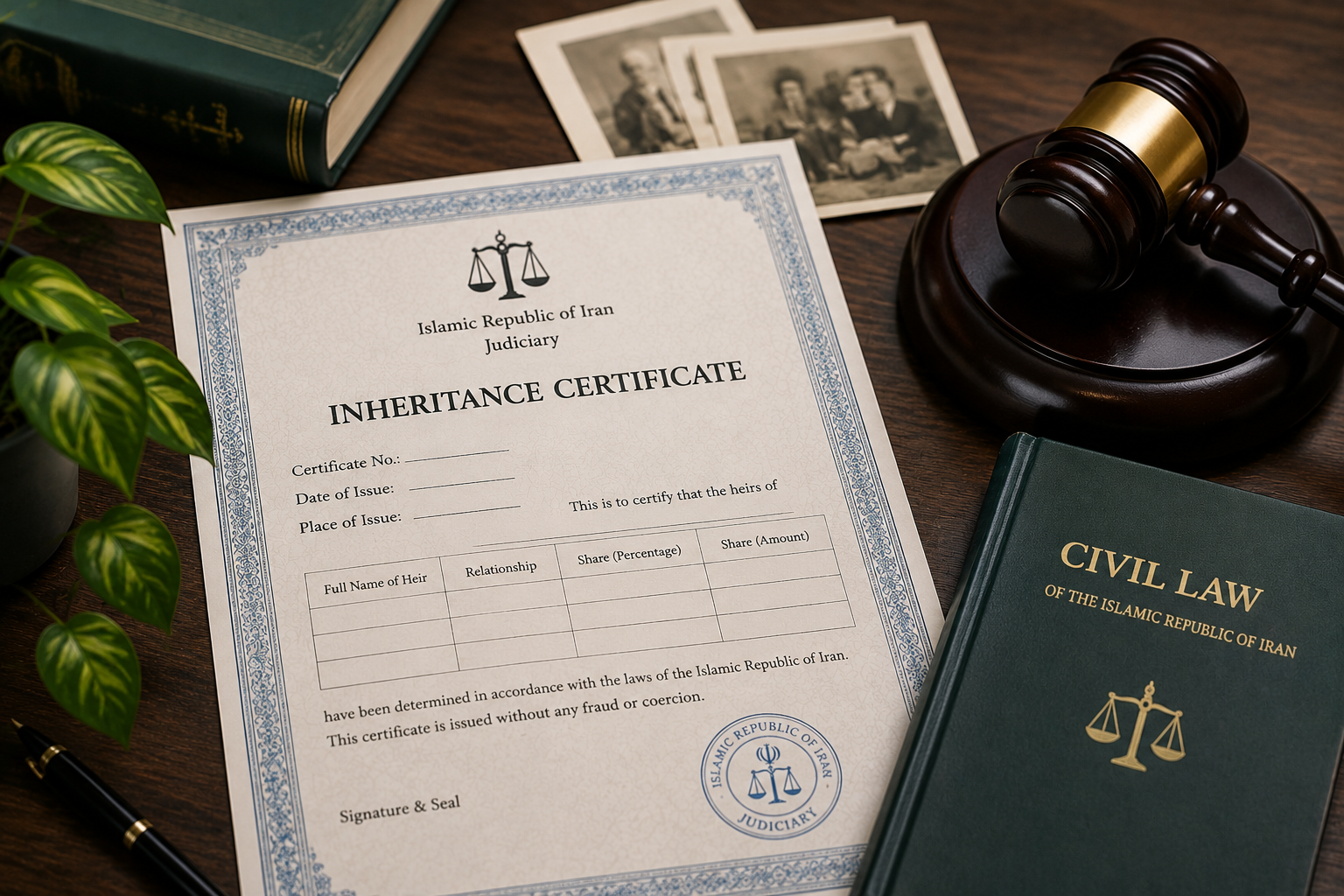
Under Iranian law, inheritance refers to the transfer of a deceased person’s assets, property, and financial rights to their legal heirs after death. Before any assets can be distributed, the deceased’s debts, financial obligations, and other legal liabilities must first be settled. The remaining assets then form the estate, which is distributed among the heirs in accordance with the Iranian Civil Code.
Iranian inheritance law divides relatives into three classes. The first class includes the deceased’s parents, children, and grandchildren. The second class consists of grandparents, brothers, and sisters. The third class includes paternal and maternal uncles and aunts. These classes inherit in order of priority. As long as at least one heir exists in a higher class, relatives in lower classes are excluded from inheritance.
For example, if a deceased person is survived by a child and two sisters, the child, as a first-class heir, will inherit according to the applicable inheritance rules, while the sisters will not inherit because heirs in the second class are excluded when a first-class heir exists.
What Is a Certificate of Inheritance?
Before heirs can claim, transfer, or divide the assets of a deceased person in Iran, they must first obtain a Certificate of Inheritance (Enhesar-e Verasat).
This certificate is an official document that identifies the deceased’s legal heirs and specifies each heir’s share of the estate. In practice, banks, land registration authorities, government agencies, stock brokerage firms, and other institutions often require this certificate before allowing any transactions involving the deceased’s assets.
Without a Certificate of Inheritance, heirs may face significant difficulties when attempting to transfer real estate, access bank accounts, sell shares, collect debts owed to the deceased, or distribute inherited property.
For this reason, obtaining a Certificate of Inheritance is generally the first legal step in the administration of an estate in Iran.
Why Is This Important for Iranians Living Abroad?
Many Iranians residing outside Iran discover that they have inherited property, bank accounts, shares, or other assets located in Iran. In such situations, obtaining a Certificate of Inheritance is usually mandatory before any inheritance-related matters can proceed.
Fortunately, heirs do not always need to travel to Iran personally. In many cases, a lawyer in Iran can handle the process on their behalf through a properly executed power of attorney. This can significantly simplify the process and save considerable time and expense.
Electronic Issuance of Certificates of Inheritance
In recent years, Iran has moved toward the digitalization of inheritance procedures.
Pursuant to Article 113(E) of Iran’s Seventh Development Plan and the Executive Regulations approved by the Council of Ministers on March 16, 2025, the National Organization for Civil Registration began electronically issuing and notifying Certificates of Inheritance from June 2025 onward.
Under the new system, many applications can be processed electronically, reducing administrative delays and simplifying the inheritance process for heirs both inside and outside Iran.
Documents Required to Obtain a Certificate of Inheritance
The documents required may vary depending on the circumstances of the case, but generally include:
- Official death certificate of the deceased
- Identification documents of the deceased
- Identification documents of all heirs
- Information regarding the deceased’s family members and legal heirs
- Any available will or testamentary documents
- Additional documents that may be requested by the competent authority
Because inheritance matters involving foreign-resident heirs often present unique challenges, additional documentation may sometimes be required.
Conclusion
Inheritance matters in Iran can become complex, particularly when heirs reside abroad or when the estate includes multiple assets, real estate, business interests, or disputes among family members. Obtaining a Certificate of Inheritance is usually the first and most important step in protecting your inheritance rights and administering the estate.
If you are an Iranian living outside Iran and require assistance with obtaining a Certificate of Inheritance, challenging an inheritance certificate, administering an estate, or resolving an inheritance dispute, experienced legal representation in Iran can help ensure that your rights are fully protected and that the process is completed efficiently.

Leave A Comment