
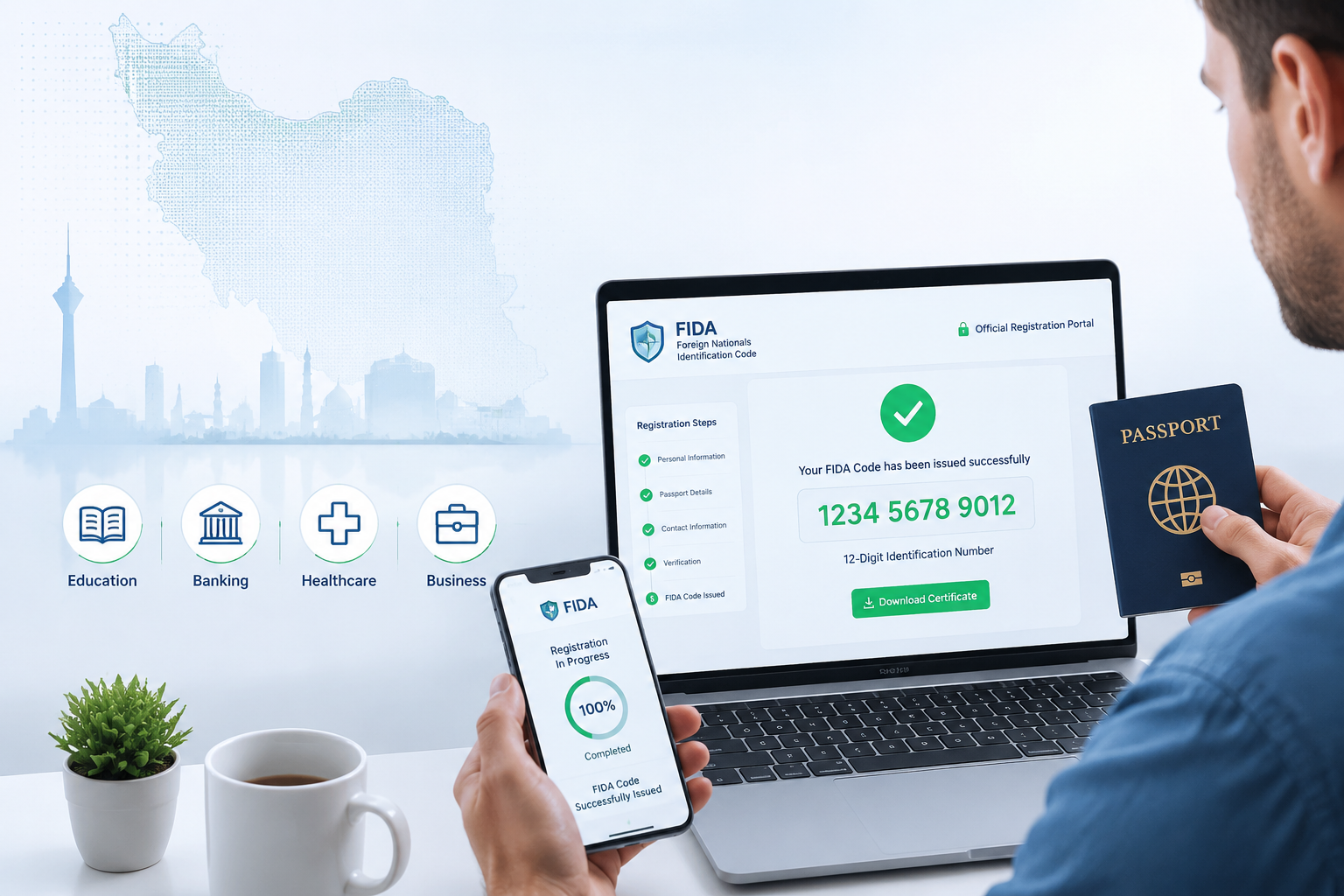
Today, to use social, educational, medical, and financial services, every individual must register their legal identity in the country’s official systems. For Iranian citizens, this identity verification is carried out through the birth certificate number and national ID code. However, foreign nationals residing in Iran, or those intending to start an economic activity or pursue education in the country, must obtain the Foreigner’s ID Assignment Code—known as the FIDA Code.
What is the FIDA Code?
The FIDA Code is a unique 12-digit identification number issued by the National Tax Administration of Iran and assigned to every foreign individual who is legally present in Iran (for educational, work, commercial, or residency purposes).
This code functions exactly like a national ID code for Iranians and is recognized in all government systems as the official identity identifier for foreign nationals.
Each digit in this code has a specific meaning, and the country’s administrative and financial systems use it to identify and verify personal and residency information.
Who Must Obtain a FIDA Code?
All non-Iranian natural and legal persons who carry out lawful activities in Iran are required to obtain a FIDA Code, including:
- Foreign students and pupils in Iranian schools and universities
- Foreign workers and employees working in domestic companies
- Foreign investors and business owners
- Foreign companies with branches or projects in Iran
- Refugees or migrants with legal residence
Therefore, any non-Iranian individual or company intending to officially use Iran’s governmental and social services must first obtain this code.
Uses of the FIDA Code for Foreign Nationals
In practice, the FIDA Code is a primary requirement for carrying out many everyday and administrative matters in Iran. Some of its key uses include:
1. Enrollment in Educational Institutions (Schools and Universities)
Foreign nationals may enroll in Iranian educational institutions only if they have a FIDA Code. This code is registered as an educational identifier in the systems of the Ministry of Science and the Ministry of Education.
2. Financial and Banking Affairs
Opening a bank account, paying taxes, buying and selling property, or registering a company all require the presentation of a FIDA Code. Without it, banks and financial organizations cannot provide services to foreign nationals.
3. Medical and Insurance Services
To receive hospital services, health insurance coverage, or membership in the Social Security Organization, having a FIDA Code is mandatory. Healthcare systems use this code to register personal details and verify residency status.
4. Participation in Official Examinations
Participation in exams such as the national university entrance exam (Konkur), master’s, or doctoral entrance exams requires registering the FIDA Code in the National Educational Testing Organization system.
5. Issuance of Driving Licenses and Traffic Services
Foreign nationals must provide a FIDA Code to obtain or renew a driving license so that their residency and identity information can be registered in the traffic police system.
6. Company Registration and Economic Activities
In the process of registering a company or obtaining an economic number, the existence of a FIDA Code is mandatory. This ensures transparency of foreigners’ activities within the country’s tax and commercial systems.
7. Residency Permit and Work Authorization
The Directorate General for Foreign Nationals and Immigrants Affairs uses the information registered under the FIDA Code to issue or renew residence and work permits.
8. Registration or Transfer of a Trademark
At the Organization for Registration of Deeds and Properties, foreign nationals must provide a FIDA Code to register or transfer their trademark so that legal identity verification can be completed.
9. Employment in Companies and Official Institutions
Having this code is necessary for employment in private or public institutions, because individuals’ insurance and employment information is recorded in official systems through this identifier.
Steps to Register and Obtain a FIDA Code
The process of obtaining a FIDA Code is entirely online and does not require in-person attendance:
- Visit the FIDA portal at portal.fida.ir
- Create a user account
- Complete the registration and enter personal information such as name, nationality, father’s name, country of birth, etc.
- Upload the required documents
- Finalize the registration and receive a tracking code
- After the documents are reviewed by the National Tax Administration, the FIDA Code is issued online
Required Documents for Registration
The required documents vary depending on the type of applicant:
For Natural Persons:
- A scanned copy of a valid passport
- A passport-style photo
- If applicable, proof of residence or refugee status: Amayesh card, residence booklet, or foreign nationals’ identity card
For Legal Persons (Foreign Companies and Institutions):
- Official company registration notice in the country of origin
- Official Persian translation of the registration notice including: company name, registration number, company type, subject of activity, address, postal code, phone number, and registration date
- If the company has a branch in Iran: identification documents of branch managers or responsible persons
Note: In some cases, the system may request additional documents such as a refugee card or passport. It is recommended to prepare all documents as high-quality color scans before starting the registration.
Processing Time for Issuance
The review and issuance of the FIDA Code usually take 3 to 7 working days. If there are deficiencies in the documents or information, processing may take longer. After approval, the FIDA identifier will be available for the applicant to view or download through the system.
Validity Period of the FIDA Code
The FIDA Code is issued permanently and does not require renewal unless the person’s identity or residency information changes (for example, change of nationality, marriage, or change of residence). In such cases, the new information must be updated in the FIDA system.
Conclusion
The FIDA Code is the cornerstone for foreign nationals to access Iran’s administrative, financial, medical, and educational systems. Without it, many official services remain inaccessible. Foreign students, entrepreneurs, and investors are advised to obtain this code immediately after legal entry into Iran. While the process is straightforward, seeking professional guidance is recommended to avoid potential complications.

Leave A Comment