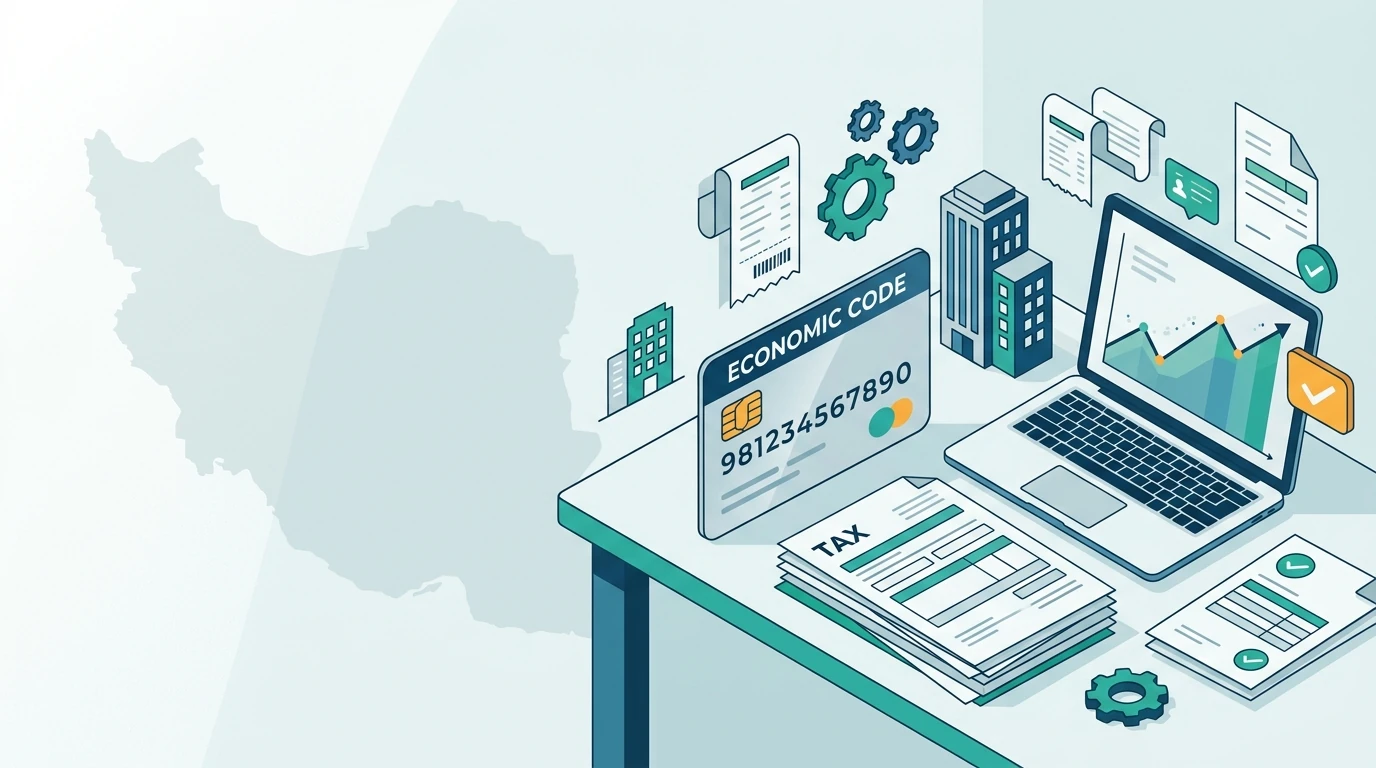
An economic code in Iran is one of the most important legal identifiers for individuals and businesses engaged in economic activities. Any natural or legal person involved in buying and selling goods, providing services, importing, exporting, or conducting any type of commercial activity in Iran needs an economic code to operate legally.
In practice, the economic code is the identifier through which the Tax Affairs Organization identifies and monitors individuals’ and businesses’ financial and commercial activities. Without obtaining this code, many official commercial and financial activities are not possible.
In this article, we explain in simple terms what an economic code is, who must obtain it, how to obtain it, and the consequences of not having one.
What Is an Economic Code?
An economic code is a 12-digit number issued by the Iran’s National Tax Administration for natural and legal persons. This code is used to identify economic actors, record transactions, and ensure transparency in financial activities.
Who Must Obtain an Economic Code?
According to tax regulations, almost all natural and legal persons who engage in continuous economic activities, including business owners subject to the Direct Taxation Law, are required to obtain an economic code.
These include:
- Commercial companies and registered institutions
- Retail stores and trade units
- Contractors and consultants
- Importers and exporters of goods
- Manufacturers and service providers
- Natural persons engaged in continuous economic activities
- Online and internet-based businesses
Persons who have obtained an economic code are required to notify the Tax Affairs Organization of any changes—such as dissolution, cessation of activity, name change, change of occupation, change of address, conversion from sole proprietorship to partnership (or vice versa), change of partners (voluntary or involuntary), or other changes—within a maximum of two months from the date of the change, or complete a new registration if required.
If a person has multiple separate businesses or business locations, they are generally required to obtain a separate economic code for each. However, if a person has a single business license but operates in multiple locations under that same license, they do not need to obtain multiple economic codes.
Why Is Obtaining an Economic Code Important?
Obtaining an economic code is not merely an administrative requirement; it is essential for legally continuing business operations.
Without an economic code, you may face the following problems:
- Inability to issue official invoices
- Difficulties in concluding commercial contracts
- Inability to participate in tenders and auctions
- Tax file complications
- Inability to obtain certain permits
- Limitations in cooperation with large companies and organizations
- Risk of tax penalties
Many companies and employers consider working with individuals who lack an economic code to be a tax risk.
Benefits of Having an Economic Code
Having an economic code offers numerous advantages:
1. Official and Legal Activity
Your business is formally registered within the national tax system and can operate transparently and legally.
2. Issuance of Official Invoices
For many transactions—especially cooperation with companies—issuing official invoices is mandatory, and this is not possible without an economic code.
3. Participation in Tenders and Auctions
Many organizations only contract with individuals or entities that have an economic code.
4. Obtaining a Commercial Card
For importing and exporting goods, obtaining a commercial card generally requires a tax file and an economic code.
5. Establishing Commercial Credibility
Having an economic code shows that your business operates officially and transparently, which helps build trust with customers and business partners.
Steps to Obtain an Economic Code
The process of obtaining an economic code is completed through the Tax Affairs Organization’s online system and generally includes the following steps:
Step 1: Registration in the Tax System
The applicant must register in the system by entering identification details, address, type of activity, and contact information. After registration, they log in using the provided username and password and select the appropriate option depending on whether they are a natural or legal person.
Step 2: Completing Information
This stage includes entering identification information, contact details, financial and tax information, banking information, business location details, and license information (if applicable).
Step 3: Review and Approval
After submission, the Tax Affairs Organization reviews the documents and information.
Step 4: Issuance of the Economic Code
After final approval, the economic code is issued, enabling the applicant to carry out official activities.
Required Documents for Obtaining an Economic Code
Required Documents for Natural Persons
- Three photographs of applicant
- Copy of business license
- Copy of all identification documents (birth certificate and national ID card)
Required Documents for Legal Entities
- Copies of all pages of passports of all board members
- Signature verification certificate for all authorized signatories
- Two copies of the company’s incorporation notice and registration amendments
- Copy of the company’s articles of association
- Company declaration or partnership agreement and application form (for non-joint-stock companies)
- Copy of operation license or establishment permit (if applicable)
- Copy of the title deed of the company’s legal address or lease agreement (if rented)
- Copy of the official gazette notice
- Letter declaring commencement or non-commencement of activity, with registered copy
- Payment of stamp duty tax to the tax office
What Is the Penalty for Not Having an Economic Code?
Failure to obtain or use an economic code in transactions may result in serious tax consequences.
Key penalties include:
- Penalty for failure to register for tax purposes
- Penalty for failure to issue official invoices
- Disallowance of company expenses for tax purposes
- Deprivation of certain exemptions and facilities
- Increased likelihood of tax audits and investigations
For example, if a company issues an invoice without including its economic code, the related expenses may not be accepted by the tax authority.
What Is the Difference Between an Economic Code and a National ID?
Many people confuse these two concepts, but they are different:
- National ID: A number issued by the Companies Registration Office to identify a legal entity.
- Economic Code: A tax identification number issued by the Tax Affairs Organization for economic activities.
Therefore, a company typically has both a national ID and an economic code.
Do Online Businesses Need an Economic Code?
Yes. In recent years, online businesses and e-commerce stores have come under increasing supervision by the tax system.
If you operate an online store, sales page, service website, or any income-generating online activity, it is advisable to clarify your tax status and obtain an economic code from the outset to avoid future legal issues.
How Is an Economic Code Cancelled?
An economic code is cancelled in the following cases:
- If a natural person declares the cessation of their economic activity
- If a natural person passes away
- If a legal entity (such as a company) is dissolved, after completion of liquidation and revocation of its operating license
- If a judicial authority issues a ruling cancelling the economic code
How Long Does It Take to Obtain an Economic Code?
After submitting documents to the Tax Affairs Organization and receiving approval, it generally takes about 14 working days for the economic code to be issued—provided there are no issues during the process.
If there are problems or incomplete documents, you must resolve them and reapply. In such cases, the processing time will vary depending on the nature of the issue.
Conclusion
An economic code is one of the most important legal requirements for conducting economic activities in Iran. Nearly all individuals and businesses operating professionally need this code for tax matters, issuing official invoices, entering commercial contracts, and conducting transparent legal operations.
If you have not yet applied for an economic code or are uncertain about your business’s tax status, it is advisable to take action before encountering legal problems or tax penalties.

Leave A Comment