
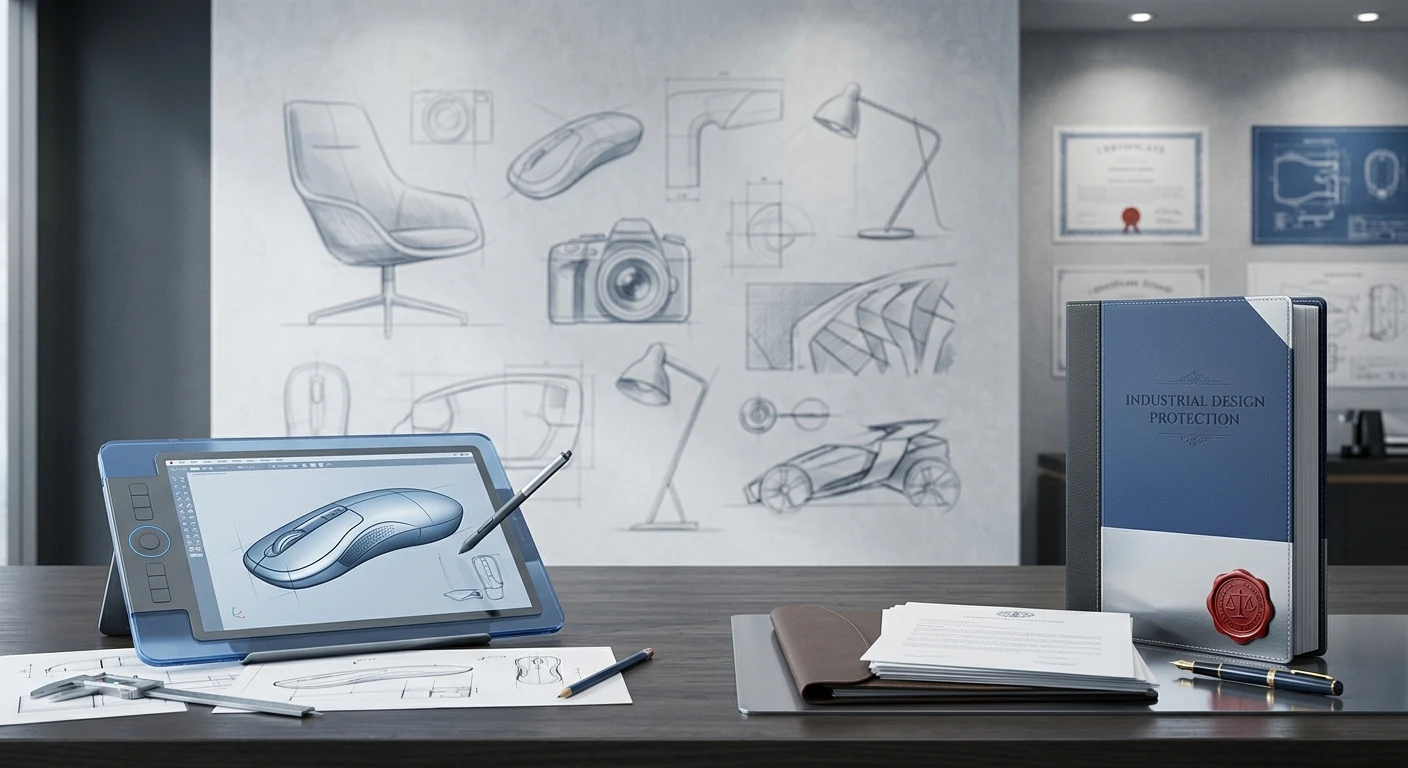
In today’s competitive market, the design and appearance of a product can play a role in the success of a business just as important as its quality. An industrial design is an effective legal tool for protecting this competitive advantage.
What is an Industrial Design?
According to Article 82 of the Industrial Property Protection Act approved in 2024 an industrial design is defined as:
Any combination of lines or colors, or both, and any three‑dimensional form, with or without lines or colors, that gives a particular visual and aesthetic appearance to an industrial product or a handicraft.
In simple terms, an industrial design relates to the external appearance of a product—what the customer sees at first glance. Therefore, any combination of lines, colors, three‑dimensional forms, or other design elements that give a product a distinctive and unique appearance can qualify as an industrial design.
For example, the distinctive shape of beverage bottles, the body design of a car, or the unique appearance of an electronic device can all be registered and protected as industrial designs.
It should be noted that if the changes are purely technical and do not affect the product’s appearance, they cannot be protected as an industrial design (they may instead fall within the scope of patents).
What Designs Can Be Registered?
For a design to be registrable and protected in Iran, it must meet two key conditions:
-
Novelty
Your design must be new, meaning that:
- It has not previously been registered, and there has been no prior application for its registration at the Intellectual Property Office of Iran.
- It has not been disclosed to the public.
Disclosure may occur through displaying the product at an exhibition, publishing images or articles about it, or even presenting it to customers.
A common mistake is that many businesses unveil their product first and only afterwards consider registering the design. This may destroy the novelty requirement and lead to rejection of the application.
-
Originality
The purpose of protecting industrial designs is to encourage creativity and innovation in product design and to improve usability compared to previous designs and products. Therefore, the design must be the result of creativity and should not merely be a copy or imitation of existing products.
Even if a design is new, it may still be rejected if it does not significantly differ from earlier designs.
What Is Not Considered an Industrial Design?
Not all designs can be registered. According to the Industrial Property Protection Act, the following are excluded from protection:
- Designs containing official state symbols or emblems
- Methods and principles of industrial design
- Designs contrary to public order or morality
- Changes limited only to the dimensions of an existing product
- Designs identical or similar to, or containing, a registered trademark of another party
- Designs that are purely functional and do not create a new visual appearance for a product
- Dependent components in composite products (spare parts)
Term of Protection
The term of protection for an industrial design is five years from the filing date of the application.
This period may be renewed for two additional consecutive five‑year periods upon payment of the required fees.
Accordingly, an industrial design may benefit from a maximum protection period of 15 years.
Rights of the Owner of an Industrial Design
Once registered, the owner of an industrial design enjoys the following exclusive rights:
- The right to manufacture products incorporating the design
- The right to sell and market such products
- The right to import products embodying the design
The owner of a registered industrial design may take legal action against any person who, without authorization, manufactures, sells, or imports products containing that design, or commits acts that may lead to infringement of the owner’s rights.
Documents Required for Registering an Industrial Design
To register an industrial design in Iran, the following documents are typically required:
- Identity documents of the applicant and the designer (For individuals, a certified copy of the national ID card; for legal entities a certified copies of the certificate of incorporation and the latest company changes)
- Images or graphical representations of the design (from different angles)
- Description of the design and identification of the products on which the design will be applied
- A written request for non‑disclosure of the designer’s name, if the designer does not wish their name to appear in the application
- Priority documents, which must be submitted simultaneously with the application or within one month thereafter (if the design has already been filed or registered in another country and the applicant wishes to claim priority in Iran)
- Power of attorney or representation documents (if the application is filed through an agent or attorney)
- Receipt of payment of official filing fees
Conclusion
Industrial designs are among the most valuable intangible assets in modern business. Registering a design not only prevents copying and misuse by competitors but also strengthens your brand’s credibility and increases customer trust in international markets. If you are a business owner, a design company, or the creator of a new product, registering an industrial design is a strategic step toward protecting your intellectual and commercial assets.

Leave A Comment